San Francisco's Commuter Benefits Ordinance requires employers to provide a commuter benefits program that supports and encourages their employees to bike, take transit and carpool to work.
Why Have a Commuter Benefits Program?
- Reduce single-occupancy driving trips which result in traffic congestion
- Decrease greenhouse gas emissions
Which Businesses Are Required to Comply?
Businesses are subject to the ordinance if they have :
- A San Francisco location and
- 20 or more employees nationwide
To report compliance, businesses must complete the SF Commuter Benefit Compliance Reporting Form.
Businesses with more than 50 employees across the Bay Area:
- Need to register with the Bay Area Commuter Benefits Program, which is administered by the Metropolitan Transportation Commission. For additional information or help with the Bay Area Ordinance, email [email protected], call 511 or from outside of the Bay Area call 510-285-3182.
- Will not need to comply with the San Francisco Ordinance or report to the San Francisco Environment Department.
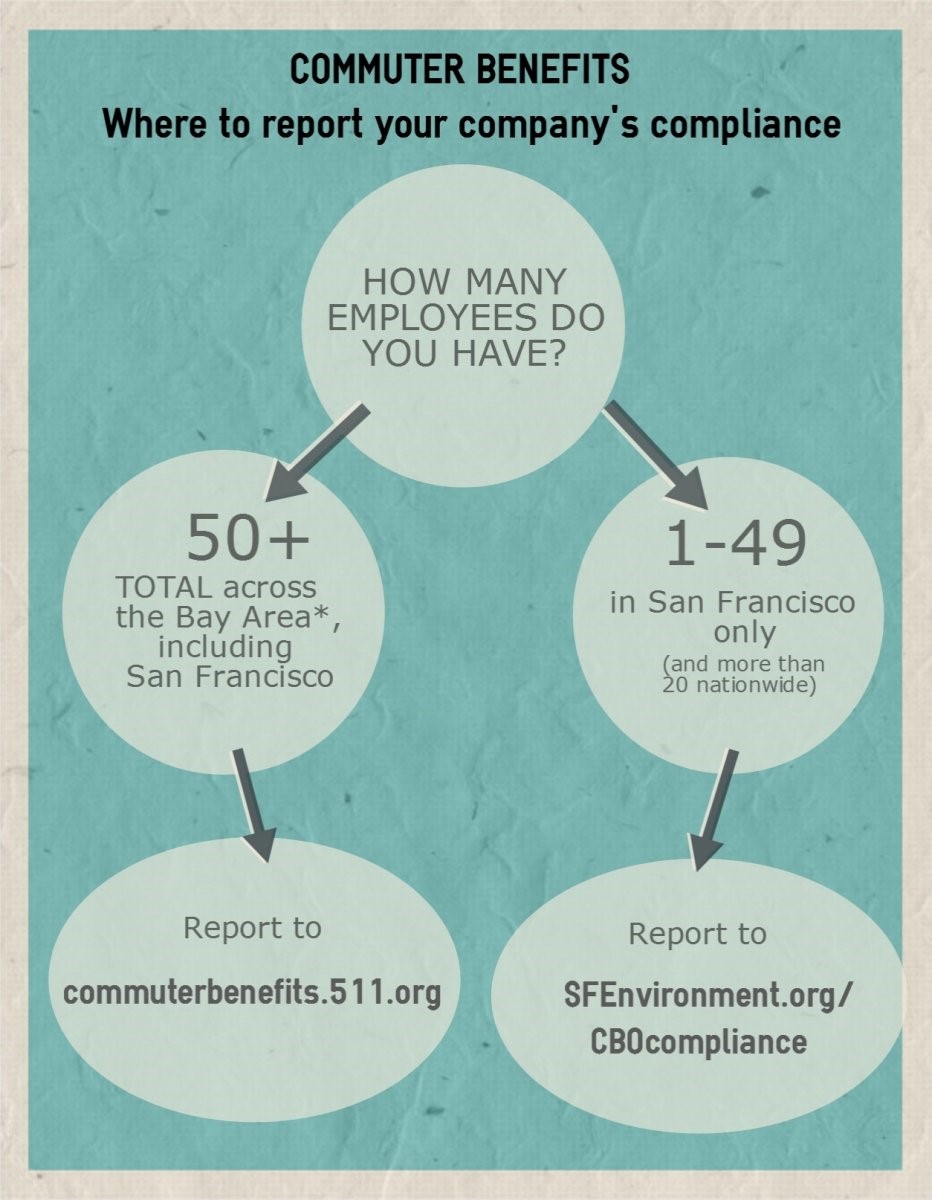
How to Comply with the San Francisco Commuter Benefits Ordinance
The San Francisco Commuter Benefits Ordinance requires businesses to offer one of the following transportation benefits:
- Pre-Tax Benefit – A monthly pre-tax deduction, up to $340/month, to pay for transit or vanpool expenses
- Employer-Paid Benefit – A monthly subsidy for transit or vanpool expenses equivalent to the price of the San Francisco Muni "A" Pass (including BART travel). View the current monthly fare.
- Employer-Provided Transportation – A company-funded bus or van service to and from the workplace
- Any combination of the above
How to Set Up a Commuter Benefits Program
For detailed information on implementing a commuter benefits program at your business, please visit the 511 SF Bay Employer Resources page where you can find a comprehensive Employer Guide, a list of Commuter Benefit Service Providers, and other helpful resources.
The SFMTA Commute Support Program is also here to help! This free program works with businesses to create tailored Employee Commute Plans, including:
- An Initial Survey to identify commute needs and opportunities
- Custom Strategies to encourage smarter, sustainable travel
- Ongoing Support to ensure successful implementation
Empower your employees with better commute options while contributing to a more sustainable San Francisco. Visit: www/sfmta.com/commutesupport and contact [email protected] to learn more and get started!
For specific ordinance assistance, email [email protected] or call (415) 355-3702.
Enforcement
The Environment Department's priority is to assist companies in implementing a low-cost benefit by providing free consultations and tools for easy compliance. For companies that do not comply with the Ordinance, the department will take the following steps as necessary:
- Warning - A written notice of violation.
- Fines - Fines will be levied 90 days after the initial written notice. Employers will be subject to a fine of $100 for the first violation, $200 for the second violation and $500 for the third violation, up to a maximum of $800.
- Please refer to the Commuter Benefits Ordinance Rules and Regulations for additional information about enforcement.
Commuter Benefits Ordinance Rules and Regulations (PDF, in English)
Frequently Asked Questions (FAQ)
FAQ - General
What is the San Francisco Commuter Benefits Ordinance?
Adopted in 2009, the Ordinance requires businesses with 20 or more employees nationwide to offer commuter benefits to their San Francisco-based employees.
Which employees are eligible?
Employees must be allowed to participate in a commuter benefits program once they reach an average of 10 hours per week, but employers are encouraged to allow all employees access to a commuter benefits program, regardless of hours worked.
To determine an employee’s eligibility, the employer may average the employee’s hours over the previous calendar month. For example, if an employee worked a total of 40 hours over one month, then 40 hours ÷ 4 weeks = average of 10 hours per week. This employee would be eligible to participate in their commuter benefits program the following month. For purposes of this calculation, employers may assume that each calendar month has 4 weeks.
I’m covered by a collective bargaining agreement
The Ordinance applies to all persons who perform work in San Francisco, including those employees covered by a bona fide collective bargaining agreement. A bona fide collective bargaining agreement is a written contract concerning wages, hours, and working conditions that is collectively bargained by an employer and a recognized union that represents the employees.
Can there be a waiting period before enrolling?
Yes, an employee’s eligibility for the commuter benefits program may be subject to a waiting period. This waiting period should be consistent with the eligibility period for other company benefits, but should not exceed one month. If the company does not offer other benefits, the employee should not have to wait longer than one month to enroll in commuter benefits.
No one at my company wants commuter benefits
The Ordinance requires you to offer a program to all eligible employees. It is up to the employee to participate in the program. If you have offered the program and no employees express interest in participating, you still need to have a program ready to go in case an employee opts into the program later or if you have a new hire who wishes to take part. In this situation, work with your payroll staff to set up the program as necessary (e.g. set up a deduction code for pre-tax deductions, set up subsidy information), talk to vendors that can provide passes or programs if an employee participates, and have your official company policy available. With these measures in place, you will be in compliance and ready to offer a program to interested employees in the future. Materials in English, Spanish and Mandarin are available for promoting the commuter benefits program to your employees
Our business just moved to San Francisco
Note: If you have 50 or more employees in the Bay Area, please see the Bay Area Commuter Benefits Program.
New San Francisco employers subject to the San Francisco Commuter Benefits Ordinance have 90 days to set-up a commuter benefits program and submit an Employer Compliance Reporting Form.
Our business just hired our 20th employee
San Francisco employers have 90 days after they become subject to the Ordinance to set-up a commuter benefits program and submit an Employer Compliance Reporting Form.
All of my employees work remotely
If all of your employees telecommute, you are not required to offer commuter benefits. You are still required to submit a Compliance Reporting Form. On the Compliance Reporting form, please mark “Exempt from the San Francisco Ordinance,” and select “All San Francisco employees telecommute” for the follow-up question about reason for exemption. If not all San Francisco-based employees telecommute, you are otherwise subject to the Ordinance and must implement a Commuter Benefits program.
If current employees telecommute, you may want to consider having a program ready to go in case an employee begins to commute to an office later or if you have a new hire traveling to an office daily. In this situation, work with your payroll staff to set up the program as necessary (e.g. set up a deduction code for pre-tax deductions, set up subsidy information), talk to vendors that can provide passes or programs if an employee participates, and have your official company policy available. With these measures in place, you will be in compliance and ready to offer a program to interested employees in the future.
My business is not located near transit (bus, light rail or train)
If your business is not located near transit, you still need to offer a commuter benefits program. You may also consider offering incentives to encourage ridesharing. The 511 Rideshare Program is an excellent resource that helps commuters find a carpool and/or vanpool partner.
FAQ - Implementation
Which program should I offer for my employees?
Because employees can have diverse commute modes, commuter benefit programs vary by company. To get a better sense of which program is best for your employees, we have created a sample employee interest survey. Once you have a better understanding of your employees’ commuting behaviors, you can assess which program will benefit them the most.
Do I need to partner with a vendor to distribute commuter benefits?
You are encouraged to work with a commuter benefits vendor to ensure that the benefit is used for qualified transportation expenses to abide by IRS guidelines. Program options and responsibilities for employers will vary with each vendor.
- Employer Managed. Employers who wish to take primary responsibility for most of the legwork involved in offering a commuter benefits program will need to take orders from employees, make payroll deductions and purchase bulk vouchers or debit/credit cards from a vendor.
- Shared Management. This option takes some of the burden from the previous program and involves more vendor engagement. In this type of program, you will be responsible for taking orders from employees, making payroll deductions and providing those orders and funds to the vendor. The vendor will supply the benefit to your employees directly as a voucher, debit/credit card or direct-deposit to Clipper Cards.
- Vendor Managed. This option entrusts the bulk of program operations to the vendor of your choice. With this option, the only responsibilities for the employer are making the payroll deductions and coordinating with the vendor. The vendor will take orders from your employees, provide and distribute the benefit and answer any employee questions about the benefit. In some cases, employees will be allowed to manage their own benefit through the vendor’s online platform.
What are some examples of vendors who can help administer commuter benefits?
For a sample list of vendors, please see 511.org's list of Commuter Benefit Service Providers.
Do I need to distribute materials?
Employers are required to make the program available to eligible employees, and that will typically involve some form of communication. In addition, employers may opt to post flyers or notifications to further advertise the program to employees. For free customizable templates available for employers to help with communicating program information, please click here.
Are there benefits for people who bike to work?
You are welcome to offer your employees post-tax benefits for biking, but unfortunately, as of January 1, 2018, the IRS Code does not allow bicycle commuting costs to be excluded from taxable wages.
Are there commuter benefits for carpooling to work?
You are welcome to offer your employees post-tax benefits for carpooling, but IRS Code does not allow carpool commuting costs to be excluded from taxable wages. Vanpooling costs on the other hand can be excluded from taxable wages per IRS Tax Code Section 132(f).
What is the difference between a vanpool and a carpool?
In the IRS Code, a vanpool is defined as any highway vehicle with seating capacity for at least six adults, excluding the driver that meets two requirements for mileage use:
- At least 80 percent of the vehicle use must be for commuter transportation, and
- When used for commuting, at least half of the seats must be occupied, on average, excluding the driver.
I have fewer than 20 employees in San Francisco, can I still implement a commuter benefits program?
Yes! Please visit the 511 SF Bay Employer Resources page and refer to their Employer Guide for detailed information on implementing a commuter benefits program at your business and find out which program is best for your company.
FAQ - Compliance Reporting Form
Where do I report compliance?
To report compliance, businesses must complete the SF Commuter Benefit Compliance Reporting Form.
Where can I find my Business Account Number (BAN)?
Please contact 311 or search the DATASF database. You can also find your 7-digit Business Account number on your Healthcare Security Ordinance Annual Reporting Form instructions.
What if I have more than one Business Account Number for my company?
Please complete a Compliance Reporting Form for each Business Account Number.
Our business has moved and is no longer in San Francisco, do I still need to complete this form?
Complete the Reporting Form and note this as your reason for exemption. If you are no longer doing business in San Francisco, you must also notify the Tax Collector.
We do not have a physical location in San Francisco but have a Business Account Number. Do we need to comply?
Complete the Reporting Form and note this as your reason for exemption. If you are no longer doing business in San Francisco, you must also notify the Tax Collector.
FAQ - Sustainable transportation programs
What programs does San Francisco offer which can enhance my company’s transportation programs?
Employers can promote the free Emergency Ride Home Program. Employees who use transit, vanpool, carpool, bicycles or walk to work on the day of an unexpected personal emergency can take a taxi or other transit home and SF Environment will reimburse them. To learn more and enroll in this free City-administered program, please visit SFERH.org.
The SFMTA Commute Support Program is also here to help! This free program works with businesses to create tailored Employee Commute Plans, including:
- An Initial Survey to identify commute needs and opportunities
- Custom Strategies to encourage smarter, sustainable travel
- Ongoing Support to ensure successful implementation
Empower your employees with better commute options while contributing to a more sustainable San Francisco. Visit: www/sfmta.com/commutesupport and contact [email protected] to learn more and get started!
You can also explore a list of San Francisco's sustainable trip programs designed to help commuters save time and money on their commute while traveling sustainably.
Additional Resources
Sample resources you may customize for your company:
SF Commuter Benefit Compliance Reporting Form
San Francisco Commuter Benefits Ordinance - Environment Code Section 427
511 SF Bay Employer Resources page
Contact Information
San Francisco Environment Department (SF Environment)
City & County of San Francisco
Phone: (415) 355-3700
Email: [email protected]


